Miami Condo Renovation Guide: HOA Rules, Permits & What to Know
Renovating a condominium in Miami is a fundamentally different experience from remodeling a single-family home. Beyond the standard considerations of design, materials, and construction, condo renovations introduce an additional layer of complexity: the homeowner’s association. HOA boards govern what you can change, when you can work, how materials are transported, and even which contractors are permitted to enter the building.
At Royal Builders Miami, we have completed hundreds of condo renovations throughout Miami-Dade County, from intimate efficiency updates in South Beach Art Deco buildings to full-scale luxury gut renovations in Brickell’s newest towers. This guide covers everything you need to know before starting your condo renovation, so you can navigate the process confidently and avoid the costly mistakes that catch unprepared owners by surprise.
Understanding the HOA Approval Process
Every condominium association maintains a set of rules and regulations governing renovations, and these vary significantly from one building to another. Before you sketch a single design idea, obtain a complete copy of your building’s renovation guidelines from the property management office.
What Most HOAs Require:
- A formal renovation application submitted to the board or architectural review committee
- Detailed plans and specifications for all proposed work, often requiring sealed drawings from a licensed architect or engineer
- Proof of contractor licensing and insurance meeting the building’s minimum requirements
- A refundable security deposit to cover potential damage to common areas during construction
- Signed acknowledgment of all renovation rules and restrictions
- Board approval before any work begins, which can take two to six weeks depending on the building’s review cycle
Common Approval Timelines: Small projects like bathroom updates or kitchen cabinet replacements may receive expedited review in one to two weeks. Full-unit renovations involving structural changes, plumbing relocations, or electrical upgrades typically require full board review and can take four to eight weeks for approval. Budget this time into your project schedule from the beginning.
What Can Be Denied: HOA boards have broad authority to reject renovation proposals that conflict with building rules, affect structural integrity, impact other units (such as through noise transmission changes), or alter the building’s exterior appearance. Common denial triggers include changing window styles visible from outside, modifying balcony railings, removing structural walls without engineering approval, and failing to meet the building’s flooring acoustical requirements.
Common HOA Restrictions You Must Know
Every building is different, but certain restrictions appear consistently across Miami condominiums.
Flooring Acoustical Requirements are among the most strictly enforced rules. Most Miami condo buildings require hard-surface flooring to achieve a minimum Sound Transmission Class (STC) and Impact Insulation Class (IIC) rating, typically STC 50 and IIC 50 or higher. This means you cannot simply install porcelain tile or hardwood directly on the concrete slab. See our guide on flooring trends for climate-appropriate material options. You must use an approved acoustical underlayment system that meets the specified ratings. The building may require laboratory test certificates proving compliance before approving your flooring selection.
Wet Area Restrictions may limit or prohibit certain types of work in bathrooms and kitchens that share plumbing stacks with other units. Moving plumbing fixtures, particularly in older buildings, can affect the water supply and drainage systems serving multiple units and may require engineering review and building-wide coordination.
Structural Modifications such as removing walls, cutting through slabs for new plumbing penetrations, or altering load-bearing elements require structural engineering approval from both the HOA and the county building department. In post-tension concrete buildings, which are common in Miami high-rises, any penetration through the floor slab requires careful mapping of tension cables to avoid catastrophic structural failure.
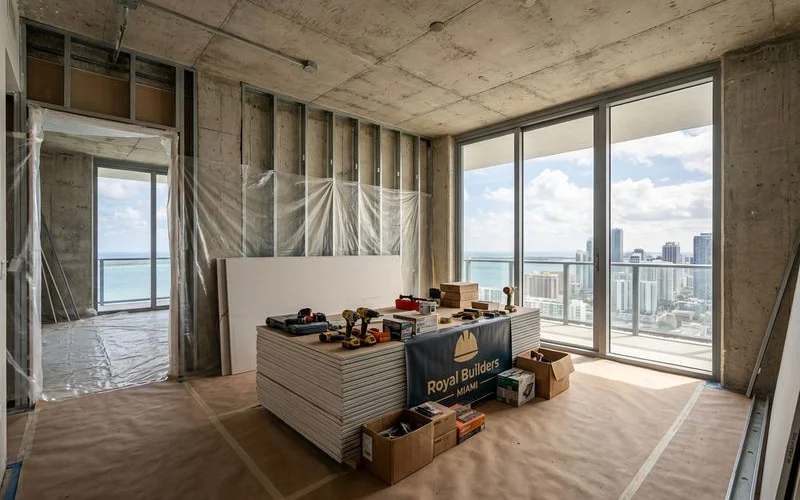
Working Hours and Noise Restrictions
Construction noise in a multi-unit building affects every neighboring unit, and HOA rules reflect this reality with strictly enforced work schedules.
Typical Permitted Work Hours:
- Monday through Friday: 9:00 AM to 5:00 PM
- Saturday: 9:00 AM to 2:00 PM (many buildings prohibit Saturday work entirely)
- Sunday and holidays: No work permitted
Some buildings further restrict heavy noise activities such as demolition, hammering, drilling into concrete, and tile cutting to a narrower window within the overall permitted hours. Luxury buildings and those with a high percentage of retiree residents tend to enforce the strictest noise policies.
Consequences of Violations: Noise violations can result in fines assessed against your unit, work stoppage orders, and in severe cases, revocation of your renovation approval. Your contractor must understand and respect these time restrictions absolutely. At Royal Builders Miami, we build the building’s specific work schedule into every condo project plan and brief our crews thoroughly before mobilizing to the site.
Elevator Booking and Material Logistics
One of the most underappreciated challenges of condo renovation is logistics. Unlike a single-family home where materials can be unloaded from a truck and walked directly into the structure, condo renovations require coordinating with building management for every delivery.
Freight Elevator Reservations must be booked in advance, often weeks ahead, through the management office. Most buildings designate specific days and times for construction material deliveries, and the freight elevator may only be available in limited time blocks. If your delivery misses its reserved window, you may wait days or weeks for the next available slot.
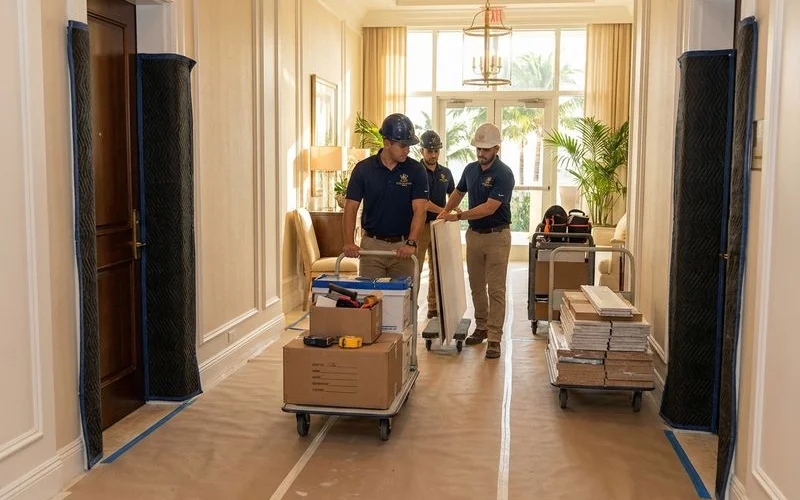
Protective Measures are typically required by the building. Your contractor must install floor protection in all common area corridors between the freight elevator and your unit, wall protection at corners and in elevators, and door protection on all common area doors used during material transport. The cost of these protective measures should be included in your contractor’s bid.
Debris Removal follows similar rules. Construction debris must be removed via the freight elevator during designated hours, using approved containers, and disposed of at facilities approved by the building. Leaving debris in hallways, parking garages, or common areas will trigger immediate fines.
Permits for Condo Renovations
Condo renovations require the same building permits as single-family home renovations. The fact that you need HOA approval does not eliminate the requirement for county permits, and vice versa. Both approvals are independently required.
Permit Requirements:
- Kitchen remodels involving plumbing or electrical changes require a building permit
- Bathroom renovations with plumbing modifications require a building permit
- Electrical panel upgrades, new circuits, and rewiring require an electrical permit
- HVAC replacement or modification requires a mechanical permit
- Any structural modifications require a building permit with sealed engineering plans
The Dual Approval Challenge: You must obtain both HOA approval and county building permits before starting work. In practice, this means submitting to both entities simultaneously and not scheduling your start date until both approvals are in hand. The HOA may also require a copy of your approved county permit before authorizing work to begin.
Insurance Requirements
Condo renovations carry specific insurance obligations that go beyond standard contractor coverage.
Your HOA Will Likely Require:
- Contractor general liability insurance of $1 million to $2 million per occurrence
- Workers’ compensation insurance for all workers on site
- The condominium association named as an additional insured on the contractor’s policy
- Proof of insurance submitted to management before any work begins
Your Personal Coverage: Review your HO-6 condo insurance policy before starting renovation. Confirm that your policy covers renovation activities and that your coverage limits are adequate for the improvements you are making. A kitchen renovation that adds $50,000 in value to your unit should be reflected in your insured value. Notify your insurance carrier before work begins.
Waterproofing: A Non-Negotiable Priority
Water damage in a condominium does not just affect your unit. A leak from your bathroom or kitchen can cascade through the ceiling of the unit below, causing damage for which you are financially responsible. Waterproofing in condo renovations is not optional; it is essential.
Bathroom Renovations must include comprehensive waterproofing of the shower area, tub surround, and floor. We recommend full membrane waterproofing systems such as Schluter DITRA or Laticrete Hydro Ban that create a continuous waterproof barrier beneath tile installations. The waterproofing must extend up walls to a minimum height of 72 inches in shower areas and cover the entire bathroom floor with a proper slope toward the drain.
Kitchen Renovations should include waterproofing beneath the sink area and around dishwasher connections. While less critical than bathroom waterproofing, a kitchen leak can cause significant damage to the unit below.
Balcony Renovations require special attention to the waterproof membrane and drainage system. Many condo buildings restrict or prohibit balcony modifications because improper waterproofing can cause structural damage to the building.
Choosing the Right Contractor for Condo Work
Not every competent general contractor is equipped to handle condo renovations. The logistical requirements, HOA coordination, and building-specific restrictions require a contractor with specific experience in the condo environment.
What to Look For:
- Demonstrated experience with condo renovations in buildings similar to yours
- Familiarity with common HOA requirements and the approval process
- Willingness to coordinate directly with building management on scheduling, elevator bookings, and material deliveries
- Understanding of acoustical flooring requirements and approved underlayment systems
- Experience with post-tension concrete structures if your building uses this construction method
- Adequate insurance coverage meeting your building’s requirements
Questions to Ask:
- How many condo renovations have you completed in the last two years?
- Are you familiar with my building’s specific renovation rules?
- How do you handle the HOA approval process?
- Can you provide references from condo owners in similar buildings?
- How do you manage noise restrictions and limited work hours?
Plan Thoroughly, Execute Flawlessly
Condo renovation success depends on meticulous planning, building-specific knowledge, and a contractor who understands that the rules of engagement are different from single-family construction. At Royal Builders Miami, we bring deep experience across Miami’s most prominent condominium buildings and a systematic approach that respects both your vision and your building’s requirements. Contact us today to discuss your condo renovation project and discover how a smooth, well-managed renovation experience should feel.